Published:
Last updated:
Direct answer: An automatic tamper is usually the better choice for a busy US cafe, a multi-barista team, or a bar that needs the same tamping step repeated throughout a shift. A manual tamper is often the better choice for a home bar or a low-volume cafe with one trained barista. Automatic tamping can make the tamp itself more repeatable. It does not replace grinding, dosing, distribution, or tasting.
This comparison is for US cafe owners, bar managers, and equipment buyers who need to choose between a handheld tamper and an automatic unit. It looks at consistency, workflow speed, ergonomics, compatibility, and cost — not at a full model-by-model specification list.
For the current CINOART range, start at the automatic tampers hub, then the CINOART PT2, PTB-FI, and PTB-MY product pages. If you already know you want an automatic unit and mainly need cost and payback context, use the guide on whether automatic tampers are worth it.
Where this page quotes CINOART figures, they are facts CINOART has confirmed or official product facts. A demonstration with your own portafilters, baskets, dose, and coffee is still the way to validate fit and workflow time.
Automatic tamper vs manual tamper: a quick comparison
| Factor | Automatic tamper | Manual tamper |
|---|---|---|
| Best fit | Busy cafes, several baristas, standardized shifts | Home bars, low volume, one consistent operator |
| Main benefit | More repeatable tamping pressure and depth across people | Low cost, flexibility, and direct tactile feedback |
| Main limitation | Purchase cost, space, compatibility, and upkeep | Technique can vary between people and over a long shift |
| What it cannot fix | Wrong grind, dose, distribution, basket, or recipe | The same process problems |
Use the table as a first filter. The sections below explain when those trade-offs matter on a real bar.
What an automatic tamper does — and what it does not
An automatic tamper compresses a prepared bed of coffee with a selected pressure and tamping sequence. The barista still grinds and doses the coffee, distributes the grounds, places the portafilter correctly, and judges the espresso after extraction. For a plain definition, see what an automatic tamper is.
A handheld, or manual, tamper is a tool the barista presses by hand. It can be consistent in the hands of one trained person. It does not hold the same force, depth, and angle for every operator, especially late in a busy shift.
Neither tool pours the shot or corrects a poor grind. If the question is how to level and press a puck by hand, use the how to tamp coffee guide. This page stays on the buying choice between the two methods.
Does an automatic tamper make espresso more consistent?
An automatic tamper can make the tamping step more consistent when different baristas use different force, depth, or wrist angles. That is most useful when a cafe wants the same starting point across shifts and new staff.
It does not guarantee an even extraction. Grind size, dose, distribution, basket condition, water, brew ratio, and machine temperature still shape the puck and the shot. A repeatable tamp applied to an unevenly distributed dose will repeat the same starting problem.
A peer-reviewed Matter study used an automated PuqPress to hold tamping constant during espresso experiments (DOI: 10.1016/j.matt.2019.12.019). That is useful evidence that a machine can control the tamping variable in a lab. It is not proof that one pressure setting produces better espresso for every cafe or every coffee.

Which method is faster during cafe service?
An automatic tamper can shorten the repeated tamping action and make the handoff easier to teach. The real time saving depends on portafilter placement, the basket, the path from grinder to tamper, cleaning between uses, and the operator. Time the complete sequence, not just the machine cycle against the downward motion of a hand tamp.
A manual tamper adds no separate machine to the bar. An experienced barista can move quickly. The process may still vary between people, and the same motion can slow down when volume is high or when the barista is already tired.
For events or short pop-ups, also count setup, wipe-down, and packing. A cafe that only needs a few carefully made shots an hour rarely gains speed from adding a machine to that path.
Which option is better for barista ergonomics?
Automatic tamping removes repeated downward pressure from the barista’s routine. That may matter in a cafe where staff tamp many shots per shift or already notice wrist, shoulder, or lower-back fatigue. It is an ergonomic consideration, not a medical treatment and not a guarantee against injury.
Manual tamping can remain comfortable when the tool, counter height, wrist position, and work volume are appropriate. If pain or fatigue is already a problem, review the whole workstation and seek qualified occupational guidance rather than treating one equipment change as a cure.
When a manual tamper is the better choice
A manual tamper is often the better buy when:
- The bar makes only a small number of shots each day.
- One trained barista controls most of the workflow and already tamps consistently.
- Technique is stable across the people who actually pull shots.
- The budget is better spent on grind quality, water, baskets, or training.
- The portafilter or basket you use does not fit the automatic unit you are considering.
A well-chosen handheld tamper also gives immediate tactile feedback. For a low-volume US cafe, that simplicity can be the point, not a compromise.
When a cafe should choose an automatic tamper
An automatic tamper is usually worth a closer look when:
- Several baristas need the same tamping process across shifts.
- The bar is busy enough that repeated tamping affects throughput or fatigue.
- You are training new staff and want fewer manual technique variables.
- Your portafilters, baskets, counter space, power, and cleaning routine are compatible.
- The expected operating benefit is larger than the machine price, installation, and service cost.
Before you treat any payback story as a plan, count shots per day, the number of operators, the time spent on the complete tamping handoff, and the local path for training and parts. Do not calculate return from a claimed machine cycle alone. For a deeper cost discussion, use the automatic tampers worth it guide, then come back to the compatibility checks below.
What to check before you buy
Ask every supplier, including CINOART, to answer the same list against the equipment you actually use.
Portafilter and basket compatibility
Confirm basket diameter, portafilter shape, support adjustment, and tamping disk size. Test the exact portafilters and baskets on your bar. A unit that fits one handle may not fit another model in the same cafe.
Per CINOART, the current in-sale models — PT2, PTB-FI, and PTB-MY — fit 58–58.3 mm baskets, including VST. If you use a different diameter, confirm fit before you order.
Layout: standalone station or grinder-matched unit
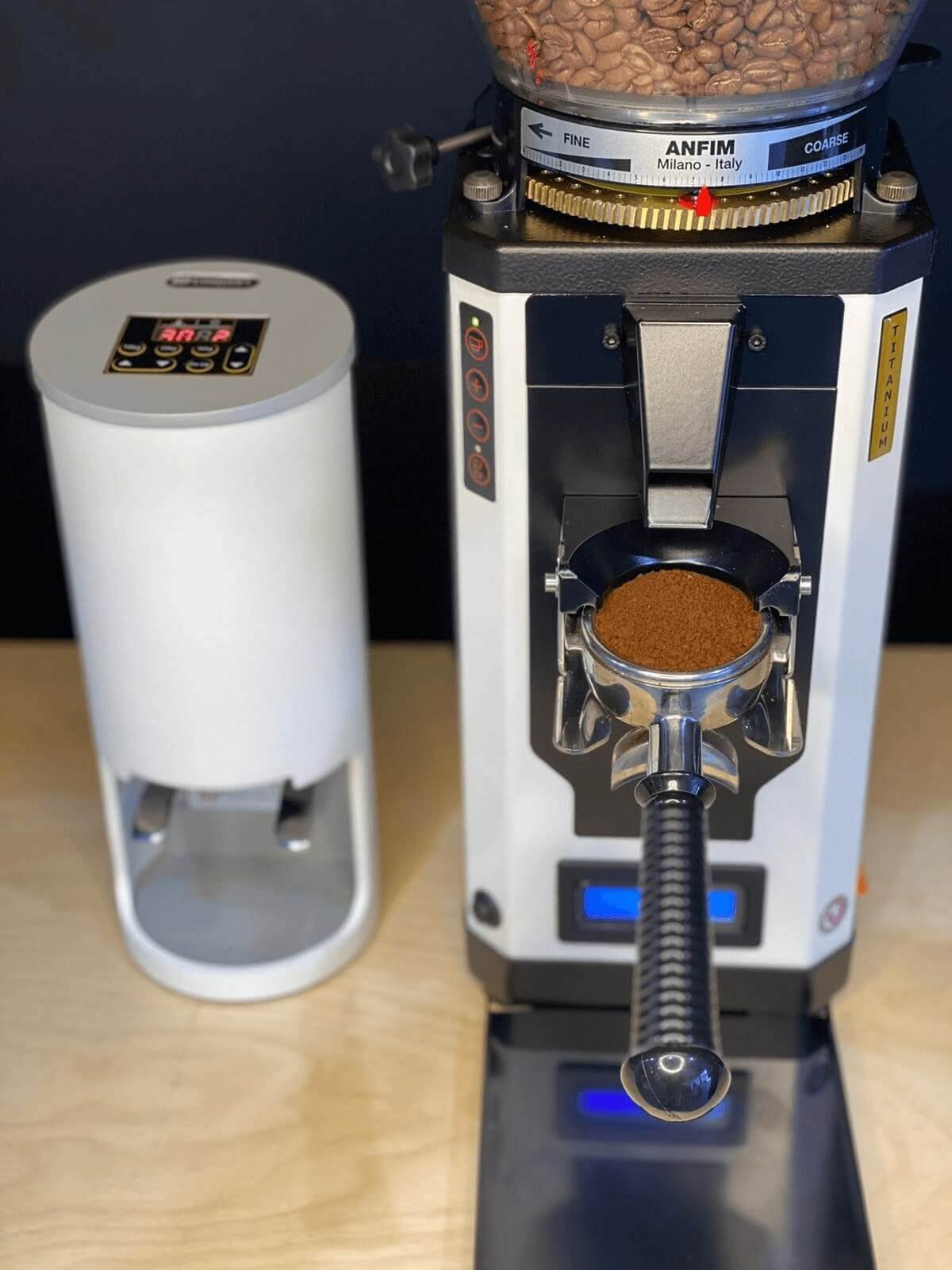
Some automatic tampers stand on the counter as their own station. Others are designed to work with a specific grinder layout. CINOART’s PT2 is the standalone option. PTB-FI and PTB-MY are intended for grinder-matched setups; the difference between those two PTB models is the grinder fit, which should be confirmed in the quote. This page does not publish a combined compatibility list. If you need that match, send photos or model names of your grinder and portafilters with the inquiry.
Cleaning, parts, and support
Ask how grounds are cleared, how often contact surfaces need cleaning, which parts wear, who handles repairs in your market, and how long replacement parts take to arrive. Warranty length for CINOART tampers is confirmed in the quotation; this page does not state a year figure for those models.
Workflow and total cost
Include purchase price, installation, counter space, cleaning time, parts, training, and downtime. Compare that total with a suitable manual tamper and with other automatic models, not with the sticker price alone.
Which CINOART automatic tamper fits this decision?
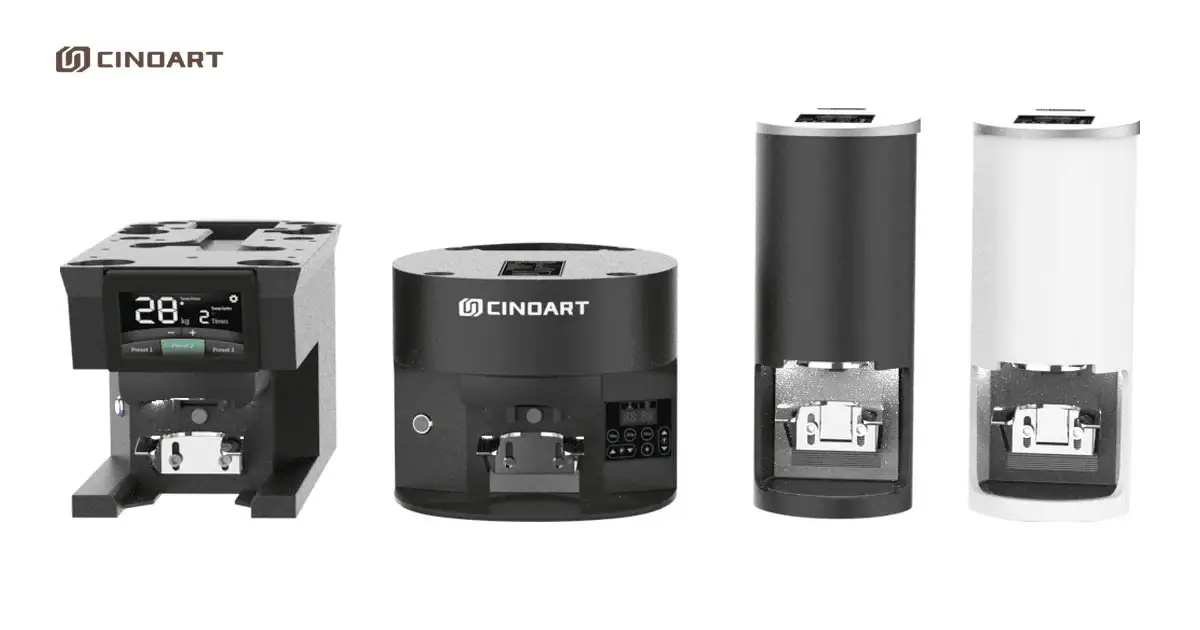
The current in-sale CINOART automatic tampers are the PT2, PTB-FI, and PTB-MY. Choose by layout and fit, not by a product photo alone.
- PT2 is the standalone countertop station.
- PTB-FI and PTB-MY are intended for specific grinder workflows. Confirm that match before you order.
- Per CINOART, all three use patented GLS and fit 58–58.3 mm baskets, including VST.
- Per CINOART, PTB-FI has a net weight of 6.15 kg (about 13.6 lb) and PTB-MY has a net weight of 7 kg (about 15.4 lb). Use those figures when you plan mounting or counter space.
CINOART quote requests are answered within 24 hours. Delivery is usually 10–15 working days after payment. Office hours are Monday to Saturday, 9:00–18:00 (the inquiry form is the starting point for a US buyer).
If you are still deciding between a handheld tamper and an automatic one, send the portafilters, baskets, and volume you actually run. If you already know you need an automatic unit, the automatic tampers hub is the place to compare the three in-sale models, then request a quote.