Quick answer: The Puqpress Q2 is discontinued. Its closest current replacement is the PUQ Press Q, a standalone automatic tamper with a $1,275 US dealer price, 53 to 58.3 mm support, five tamp modes, and a two-year or 300,000-tamp warranty. The M3 and M5 are grinder-integrated models. The Mini is the smaller standalone option. The Navigator isn’t a tamper at all: it’s an automatic WDT distribution tool.
Proof line: CINOART has built automatic tampers since 2018, with 33 patents and 200+ clients. We also published a 2021 cross-brand automatic tamper review, so this comparison includes the awkward part most buying guides skip: where a competitor is the better fit.
Which Puqpress model should you buy?
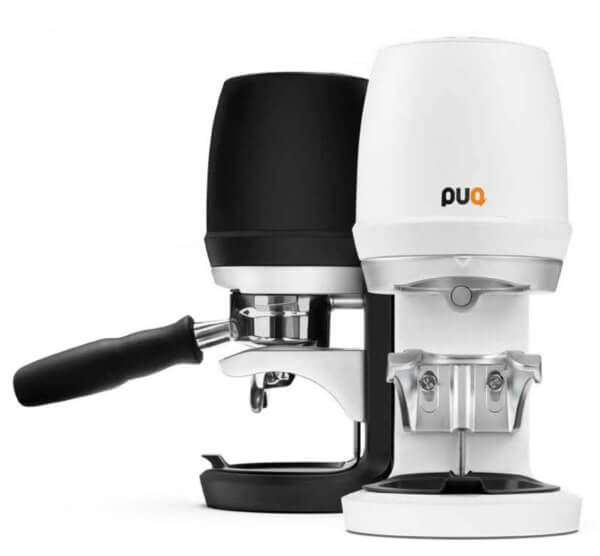
For a standalone tamper, the current PUQ Press Q is the closest replacement for the discontinued Q2. Choose the Mini for a smaller, lower-volume bar, the Pro for heavier use and longer warranty coverage, and an M-series model when the tamper should live under a compatible grinder. Don’t choose Navigator as a tamper because it distributes coffee instead of compressing it.
The name changed, which is the first small trap. The company now uses PUQ, while old reviews and search results still say Puqpress. Q2 is an older standalone model. Q1 and M1 are also older names. The current range starts with Q, Pro, and Mini, then continues through the integrated series.
The second trap is the word “automatic.” An automatic tamper presses the puck. An automatic WDT tool distributes the grounds before tamping. Both are useful. They are not interchangeable, unless your business plan includes selling coffee to a very confused puck.
| Model | What it is | Best fit | Current US dealer price | Status |
|---|---|---|---|---|
| PUQ Press Q | Standalone automatic tamper | Most standalone commercial bars | $1,275 | Current |
| PUQ Press Pro | Standalone automatic tamper | High-volume bars needing a longer warranty | $1,680 | Current |
| PUQ Press Mini | Smaller standalone automatic tamper | Lower-volume bars and compact counters | $940 | Current |
| M3 | Integrated tamper for Mahlkönig E65S workflows | Bars using a compatible grinder | $1,490 | Current |
| M5 | Integrated tamper for Mahlkönig E80S workflows | Higher-volume bars using a compatible grinder | $1,520 | Current |
| Q2 | Older standalone automatic tamper | Existing owners seeking parts or a replacement | $1,000 to $1,750 in owner reports | Discontinued |
| Navigator | Automatic WDT distribution tool | Consistent pre-tamp distribution | $450 | Current, not a tamper |
Price source: US dealer snapshots checked 31 October 2026 at Voltage Coffee Supply and Espresso Outlet. The Q2 owner-price range comes from the 2022 CINOART comparison thread and later owner discussions, not a current official price list.
Is the Puqpress Q2 discontinued?
Yes. The Q2 is discontinued, and the current standalone successor is the PUQ Press Q. The current Q keeps the Q2’s main shape: 53 to 58.3 mm support, 5 to 30 kg pressure in 1 kg steps, five modes, a 76 W motor, and a two-year or 300,000-tamp warranty. The official site no longer lists Q2 as a current product.
The old Q2 still appears in search results because the internet has the memory of an elephant and the filing system of a teenager. A review from 2021 can remain useful for the older machine, but its price, warranty, and availability shouldn’t be treated as today’s offer.
The current PUQ Press Q specifications are the safer reference for a new purchase. If you’re buying a used Q2, confirm the exact generation, pressure head, basket support, service history, and local parts support before sending money.
Q2 versus current Q: what changed?
The current Q is the closest official replacement for the Q2, but a replacement isn’t automatically the same production unit. The current model has five named modes, a 5 to 30 kg range, a 25 kg weekly coffee guideline, and 300,000-tamp warranty coverage. Old Q2 pages and dealer listings can show different warranty terms, prices, or generation labels.
| Detail | Q2, older model | PUQ Press Q, current model |
|---|---|---|
| Availability | Discontinued | Current |
| Pressure range | 5 to 30 kg in 1 kg steps, from archived specifications | 5 to 30 kg in 1 kg steps, from the official Q page |
| Basket support | 53 to 58.3 mm, from archived specifications | 53 to 58.3 mm, official |
| Modes | Five modes listed in current successor documentation | Speedy, Precision, Hulk, Soft, Single |
| Warranty | Varies by market and generation | Two years or 300,000 tamps, official |
| 2021 price reference | $1,290 in CINOART’s archived comparison | $1,275 at the dealer snapshot checked 31 October 2026 |
The price has barely moved in this comparison. That doesn’t mean every quote will match it. Dealers set local pricing, shipping and tax change the final number, and used Q2 listings are their own little weather system.
What is the difference between the Puqpress Q, Pro and Mini?
The Q, Pro, and Mini are standalone automatic tampers. The Q is the general-purpose current model. The Pro adds a profile switch, mirror tray, unlimited weekly coffee guidance, and a three-year unlimited-tamp warranty. The Mini is lighter, smaller, limited to three modes, and rated for up to 7 kg of coffee per week.
| Model | Pressure | Modes | Weekly coffee guidance | Warranty | Size and weight |
|---|---|---|---|---|---|
| PUQ Press Mini | 10 to 30 kg | Speedy, Precision, Single | Up to 7 kg | Two years or 150,000 tamps | 18.1 × 13.6 × 27.2 cm, 3.4 kg |
| PUQ Press Q | 5 to 30 kg | Five modes | Up to 25 kg | Two years or 300,000 tamps | 19.5 × 14.1 × 28.3 cm, 3.8 kg |
| PUQ Press Pro | 5 to 30 kg | Five modes with profile switch | Unlimited | Three years, unlimited tamps | 19.5 × 14.5 × 30.1 cm, 4.1 kg |
Specs come from the official Mini page, official Q page, and official Pro page.
The Mini makes sense when counter space and volume are both modest. The Pro makes sense when the machine will work hard enough that warranty length matters. The Q sits between them, which is a very respectable place to sit. Not every product needs to be the sports car of tamping.
What is the difference between the Puqpress M3 and M5?
The M3 and M5 are integrated automatic tampers designed to work with different grinders. The M3 fits Mahlkönig E65S and E65S GbW workflows. The M5 fits Mahlkönig E80S and E80 GbW workflows. The choice follows the grinder, not a ranking where M5 wins because its number is larger.
| Model | Grinder workflow | Pressure | Capacity or guidance | Weight | Current US dealer price |
|---|---|---|---|---|---|
| M3 | Mahlkönig E65S and E65S GbW; brackets can also support other grinder setups | 5 to 30 kg | Two-year warranty, unlimited tamps | 4.6 kg | $1,490 |
| M5 | Mahlkönig E80S and E80 GbW; bracket options support other setups | 5 to 30 kg | 10 kg or more per week | 5.5 kg | $1,520 |
Read the official M3 specifications and official M5 specifications before choosing a bracket. Dealer pages can list extra compatibility kits, but the grinder in your bar still needs to be checked by model and generation.
An integrated model saves a separate tamping station and keeps the workflow near the grinder. It can also lift the grinder higher. That sounds harmless until the shortest barista has to reach it all morning and starts looking at the equipment like it’s a personal enemy.
Choose M3 or M5 when:
- The grinder is already compatible.
- The bar benefits from one compact grinder-to-tamp workflow.
- The team wants fewer handoffs between dosing and tamping.
- The added height works for every person on the bar.
Choose a standalone Q, Pro, or Mini when:
- You may replace the grinder later.
- You use more than one grinder brand.
- You want the tamper in its own station.
- You need to move the machine between work areas or events.
No. The PUQ Prep Navigator is an automatic WDT distribution tool, not an automatic tamper. It uses needles to distribute coffee grounds before tamping, with Standard, Speedy, Precision, and Delay modes. It runs about 500 to 800 cycles per charge, charges through USB-C, and has a two-year warranty.
The official Navigator page places it in the Prep range, separate from the Press tampers. Its job is to move and distribute the grounds. The tamper’s job is to compress the prepared puck.
That distinction matters when you’re planning a workflow:
- Grind and dose the coffee.
- Use a distribution tool such as Navigator if the recipe calls for it.
- Tamp with a manual or automatic tamper.
- Lock in the portafilter and extract.
Buying Navigator because you need a tamper is like buying a whisk because you need a frying pan. Both belong in the kitchen. Your eggs remain unconvinced.
Navigator may be useful for a bar that wants repeatable distribution and tamping as two separate steps. It isn’t a cheaper replacement for Q2, Q, Mini, Pro, M3, or M5.
Which Puqpress model fits a commercial coffee bar?
A commercial bar should choose the model by workflow, volume, grinder fit, and service plan. The Q is the safest standalone starting point. The Pro is the heavy-duty standalone option. M3 and M5 make sense when the grinder match is already fixed. Mini fits lower-volume work. Navigator only belongs in the distribution step.
| Bar situation | Shortlist | Why |
|---|---|---|
| One small bar with a compatible E65S grinder | M3 | Integrated workflow without a separate station |
| One small bar with a compatible E80S grinder | M5 | Integrated workflow for the larger grinder family |
| Busy bar with several baristas | Q or Pro | Shared tamp settings across shifts |
| High-volume bar with a long service day | Pro or a compatible integrated model | Longer warranty or a fitted grinder workflow |
| Small counter or lower-volume café | Mini or manual tamper | Lower footprint and lower capacity target |
| Bar that changes grinders often | Q, Pro, or Mini | Standalone equipment is easier to move |
| Bar trying to improve distribution | Navigator plus a tamper | Navigator does not compress the puck |
The workflow is more important than the logo on the machine. A bar with unstable grind, uneven distribution, or an incorrect basket size won’t be rescued by a very expensive box with excellent posture.
Do Puqpress machines improve espresso consistency?
Automatic tampers can improve repeatability when several baristas tamp differently or when repeated manual tamping causes strain. They don’t guarantee better espresso by themselves. Grinding, dose, distribution, basket, water, extraction, and recipe still control the result.
A peer-reviewed Matter study used an automated PuqPress at 98 N to standardize tamping during espresso experiments. The study found that the tested tamping pressures did not create a dramatic change in extraction yield or shot time. Read the original study.
The useful conclusion is less exciting and more valuable: a Puqpress is a repeatability tool. It removes one human variable. It does not turn a bad grind into a good one, and it certainly doesn’t taste the shot afterward. I checked. The machine remains stubbornly silent on tasting notes.
The injury question is different. Sprudge reported on research into push tampers and the risk of repeated force and awkward wrist movement in espresso preparation. Read the report. For a busy bar, reduced repetition can be part of the business case even when the espresso recipe stays the same.
What do Puqpress owners complain about?
Owner reports split into two useful groups: some users say the machines save their wrists and keep the workflow consistent, while others report gear-drive or induction-sensor failures and frustration with service access. Neither side is the whole story. Reliability depends on generation, workload, maintenance, and local repair support.
A 2025 café-owner discussion reported three failures over five years but also said the machine had saved the owner’s wrist. A coffee technician in the same discussion described a busy customer using one for three years at 12 kg of coffee per day, with an induction sensor as the only reported repair. Read the full discussion.
Other recurring owner concerns include:
- Basket and portafilter fit: Some owners report trouble with stock La Marzocco Linea Micra portafilters and certain ridged baskets. See the fit discussion.
- Cleaning: Grounds collect around the base, so the machine needs regular brushing during service.
- Counter space: A standalone unit takes room that a small bar may not have.
- Serviceability: Some owners describe the Q2 as tight to service, while M-series units can be easier to access.
- Cost: A machine close to $1,000 or more has to solve a real operating problem.
The fit check is not a boring formality. Confirm the basket diameter, portafilter shape, grinder arrangement, voltage, local warranty, and parts path before you buy. Your future self will thank you, probably by not sending an angry email at 6:15 a.m.
What we see in the field: the machine should fit the workflow
CINOART’s automatic tamper range includes PT1 and PT2 standalone machines, plus PTB-MY for Mythos and Anfim workflows and PTB-FI for Fiorenzato workflows. That product range leads to the same conclusion as this comparison: the right automatic tamper is the one that fits the bar’s real movement.
Here are the five checks we use before discussing a model:
- Where does dosing happen? If the portafilter already sits under a grinder, an integrated model may remove a handoff.
- How many people tamp? More baristas create more opportunities for technique to drift.
- How many shots run during the rush? Repetition is where automation earns its keep.
- What basket sizes are in use? The machine must match the actual portafilters, not the one product photo you liked.
- What happens when the machine needs help? Warranty, parts, and service access matter as much as the first-day demonstration.
CINOART’s typical factory-direct automatic tamper price band is $500 to $1,000, with a minimum order of one unit, a small-order lead time within seven days, and a standard one-year warranty. Those are CINOART terms, not Puqpress terms. The final CINOART quote depends on product, configuration, quantity, and destination. See the CINOART automatic tamper range or request a quote.
CINOART is a competitor, so the comparison should be read that way. The useful question isn’t “Which logo wins?” It’s “Which machine removes the problem your bar actually has?” A fancy answer to the wrong problem is still a fancy wrong answer.
Is the Puqpress worth it for home use?
Usually not for a home bar making a few shots a day. A Puqpress becomes easier to justify at home when the owner has wrist pain, makes high volumes, shares the bar with several people, or values automation more than the purchase price. For most home users, a good manual tamper costs less and does the job.
The same pattern appears in owner discussions. One home user described a Q2 as valuable for a repetitive strain injury, while other owners called commercial automation excessive for two drinks a day. Read the home-use discussion.
For a café, the calculation changes because the machine can serve hundreds of shots, multiple shifts, and a real training process. For a home bar, the same machine may spend most of its life standing beside the grinder, looking like it has somewhere important to be.
Frequently Asked Questions
Is the Puqpress Q2 still available?
The Q2 is discontinued. The current standalone replacement is the PUQ Press Q, which has a similar 53 to 58.3 mm support range and five tamp modes. Used Q2 buyers should confirm generation, fit, warranty, and parts support before purchasing.
What replaced the Puqpress Q2?
The PUQ Press Q is the closest current standalone successor to the Q2. The Pro is the higher-capacity standalone option, while the Mini is the smaller and lower-capacity option. The best replacement depends on volume, counter space, and warranty needs.
Is the Puqpress M3 or M5 better?
Neither is universally better. The M3 is designed for Mahlkönig E65S workflows, while the M5 is designed for Mahlkönig E80S workflows. Choose by grinder compatibility and bar layout, not by the model number alone.
No. Navigator is an automatic WDT distribution tool. It distributes coffee grounds before tamping, while a Q, Pro, Mini, M3, or M5 compresses the prepared puck.
How much does a Puqpress cost?
The US dealer snapshot checked 31 October 2026 listed the Mini at $940, Q at $1,275, Pro at $1,680, M3 at $1,490, and M5 at $1,520. Dealers set local prices, so shipping, tax, currency, and availability can change the final quote.
Does a Puqpress replace a barista?
No. It automates tamping. A barista still controls grinding, dosing, distribution, recipe choice, extraction, tasting, cleaning, and service. The machine removes one repeatable action, not the coffee knowledge around it.
The short answer
The Q2 is a discontinued standalone tamper. Buy the current PUQ Press Q if you want the closest current replacement, the Pro if you need the longest standalone warranty and heavier capacity, the Mini for a smaller lower-volume setup, M3 or M5 for a compatible grinder workflow, and Navigator only when you need automatic distribution before tamping.
If your bar’s problem is inconsistent tamping across people and shifts, compare the machine against that problem. If the problem is grind, dose, distribution, or a basket that doesn’t fit, start there. The puck is very good at reporting bad decisions.
If you want a second comparison from a manufacturer that builds automatic tampers, read the CINOART automatic tamper range and the automatic tamper comparison with CINOART PT2.
Sources
- PUQ Press Q official specifications
- PUQ Press Pro official specifications
- PUQ Press Mini official specifications
- PUQ Press M3 official specifications
- PUQ Press M5 official specifications
- PUQ Prep Navigator official specifications
- Voltage Coffee Supply PUQ Press Q listing
- Espresso Outlet PUQ Press collection
- Systematically Improving Espresso, Matter
- Sprudge report on push tampers
- Reddit owner discussion on reliability
- Reddit discussion on La Marzocco portafilter fit
- CINOART automatic tamper range